Source: My personal archive
What My Six-Year-Old Taught Me About Strategy, Leadership, Life—and Even War
A few days after International Women’s Day, I found myself reflecting on an unexpected lesson about strategy—and perhaps about life, leadership, and even war.
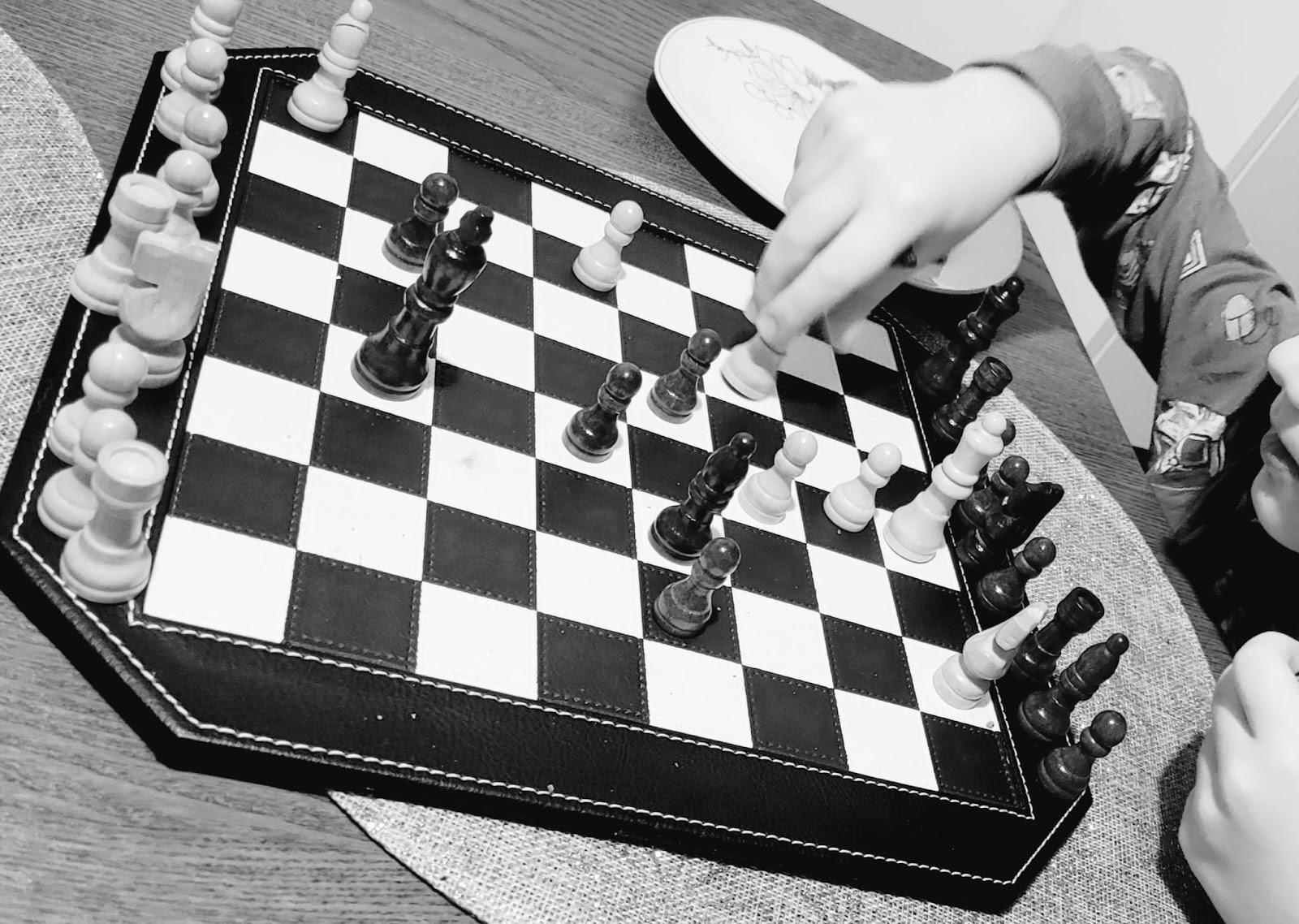
It came from my six-year-old son—during a chess game.
He called it the Elodian Method.
I absolutely love my six-year-old son. But I also admire him deeply, and many times I find myself following his lead. He is a visionary in his own way—a strategic thinker, a natural problem solver, and a child with an instinctive pursuit of excellence. What fascinates me most is how naturally he explores ideas, tests possibilities, and searches for better ways to do things. Every day, he teaches me something new about life.
Recently, he started learning chess at school. From time to time we play together at home, and he enjoys it immensely—especially when he wins. Part of that is because I want to encourage his confidence. But the truth is that I also lack practice. I learned the rules of chess on my own, without much guidance, and never went much deeper than that.
One day, he came to me with great excitement.
“Mommy,” he said very seriously, “I want to teach you a method.”
He called it the Elodian Method.
He explained that the strategy was simple—but it required two rules to work together.
First, promote as many pawns as possible into queens. The pawns should move quickly into the opponent’s territory so they can reach the last rank and transform. The more queens you have on the board, the more freedom and power you gain.
In his imagination, the board would eventually be ruled by queens.
But this could only work if the second rule was respected at the same time: the king must always remain protected—defended by at least one queen and one rook.
Attack and defense, advancing together. Expansion and protection.
And as I listened to him explaining the rules of his method, I could not help smiling at the thought that, in our games—and quite often in life as well—he seems to be the king, and I am happily following his lead.
In his words, the strength of the method was simple: turn the weakest pieces into the strongest pieces.
Listening to him, I realized that hidden inside this playful invention was a surprisingly real strategic principle.
Maximize resources and minimize constraints.
On a chessboard, pawns are the most limited pieces. They move only one square at a time, and only forward. Their movement is constrained and their influence small.
But once a pawn reaches the end of the board, it transforms into a queen—the most powerful and flexible piece in the game. A queen can move freely across ranks, files, and diagonals with almost no limitations.
What my son instinctively understood was this: the objective is not only to accumulate pieces, but to transform constrained resources into unconstrained ones.
In other words, turn pieces that can barely move into pieces that can move almost anywhere.
And perhaps this idea reaches far beyond the chessboard. In life, in business, in leadership, and even in real war, the real breakthrough often comes not from acquiring more resources, but from unlocking the freedom and potential of the ones we already have.
Then came the twist.
After explaining his strategy with great seriousness, he suddenly smiled and confessed:
“Mommy… this is just a joke. I made it up. There is no Elodian Method in any chess book.”
I had even searched the internet for it, convinced he must have learned it at school.
But he hadn’t.
He invented it.
And that moment revealed another lesson.
On the chessboard, everything is visible. The pieces stand in plain sight. The rules are clear.
But real life is different.
In life, not everything is visible. There is imagination, creativity, and sometimes disguise. Not every strategy is written in a book.
Sometimes the most powerful ideas are the ones someone simply invents.
Children understand this naturally.
Adults often forget.
So perhaps the Elodian Method does exist after all—just not in a chess manual.
Maybe it simply means this:
Use every resource you have.
Transform potential into strength.
Protect what matters.
And when no path seems visible—find a way, or make a way.
Note.
A quiet tribute to the mothers in my life—and, in the spirit of International Women’s Day, to the strength that travels across generations of women.
My mother passed away almost forty-five years ago; she could have been seventy-three around these days, yet remained forever twenty-nine, and I like to imagine her watching us from heaven.
My grandmother, who has reached ninety-eight and still carries a free and lucid spirit. Even if the body has slowed, she reads all day and laughs at small things with the same genuine joy she always had, no matter how hard life was. From her I learned many of the good things about life: faith and moral compass.
My aunt, who was my role model for femininity, elegance, motherhood, generosity, and resilience.
And to many other women in my life—my other grandmother, aunties, friends, colleagues, even adversaries and brief encounters—all of them, in their own way, helping shape the woman and the human being I am today.
♟️